Get a Quote Get a Quote Phone Phone WhatsApp WhatsApp Contact Us Contact Us

Technology

Three Decades of Web Evolution, One Continuous Capability

Image Online’s relationship with technology did not begin with a framework, a programming language, or a trend. It started with the web itself.

When the internet entered India in 1995, long before digital transformation became a boardroom mandate, Image Online was already building systems on the web. Over the last three decades, we have lived through every major shift in how digital platforms are designed, deployed, scaled, and governed from static websites to enterprise platforms, from desktop-first systems to mobile-first ecosystems, and now toward AI-assisted, phygital operations, demonstrating our proactive adaptation to future trends.

For us, technology is not just a toolset. It is a continuously evolving operating layer for business, ensuring our solutions remain adaptable and future-proof giving clients confidence in our strategic vision.

What follows is not a list of technologies we "support," but an explanation of how and why each technology exists within our execution DNA.

Core Web & Backend Technologies

Core Web & Backend
Technologies

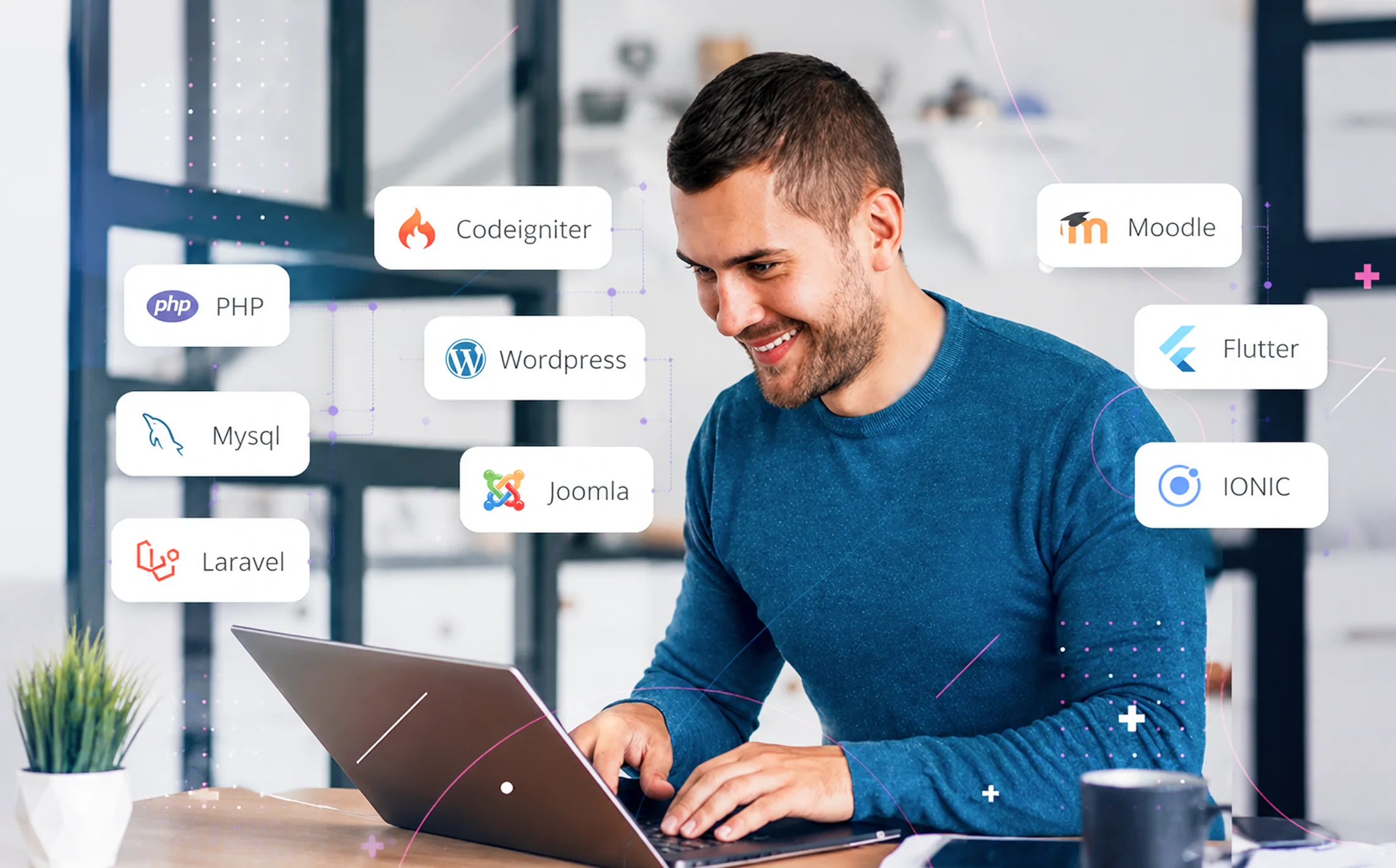
PHP

PHP has been a foundational technology in Image Online’s journey and remains strategically relevant today. Its maturity and stability reassure our clients of our commitment to reliable, long-term solutions for enterprise portals and large-scale applications.

Over the years, PHP has evolved from simple scripting into a robust backend language capable of handling complex workflows, integrations, and high-traffic systems. Our experience allows us to architect PHP systems that are structured, secure, scalable, and future-ready, rather than fragile or monolithic.

MySQL

MySQL has been a core data layer for many of our systems, particularly where structured relational data, transactional integrity, and performance reliability are critical. We use MySQL not just as a database, but as part of a disciplined data architecture that supports reporting, analytics, and long-term system evolution.

In ERP-like systems, multi-location platforms, procurement systems, and operational dashboards, MySQL provides the stability required for mission-critical data without introducing unnecessary licensing complexity. Our designs ensure that data models remain clean, auditable, and scalable over time.

Laravel

Laravel represents structured PHP development done right. We use Laravel when applications require strong architectural discipline, role-based access controls, API-driven design, and long-term maintainability. It is particularly effective for enterprise systems, SaaS platforms, fintech-related applications, and integration-heavy solutions.

Laravel allows us to enforce consistency, security, and scalability without sacrificing development speed. It fits nicely in environments where systems are expected to evolve continuously rather than remain static after launch.

CodeIgniter

CodeIgniter plays a different role. It is used where lightweight performance, simplicity, and rapid execution are more important than heavy abstraction. For systems that require fast turnaround, lower overhead, and straightforward logic especially internal tools or operational platforms CodeIgniter remains highly effective.

Our experience allows us to choose CodeIgniter consciously, not as a compromise, but as an optimisation where architectural simplicity delivers better outcomes.

Content, Learning & Platform Frameworks

Content, Learning &
Platform Frameworks

WordPress

At Image Online, WordPress is not treated as a “website builder.” It is treated as a flexible content and application framework. We use WordPress where content governance, editorial workflows, and extensibility are required often heavily customised and integrated with external systems

WordPress-based systems we build frequently extend far beyond blogs or marketing sites, evolving into portals, multi-role platforms, and content-driven business systems with strict access control and operational logic.

Joomla

Joomla is used in environments that demand structured content hierarchies, advanced access control, and multi-user governance. It has proven helpful in institutional, association-based, and enterprise publishing contexts where content ownership and permission management are central.

Our Joomla implementations focus on stability, governance, and long-term usability rather than visual complexity.

Moodle

Moodle is central to our learning and training platforms. We use it to build structured, auditable learning environments for institutions, enterprises, and compliance-driven organisations.

Rather than treating Moodle as a standalone LMS, we integrate it with operational systems HR, compliance tracking, certification workflows, and reporting dashboards making learning a governed business process rather than an isolated activity.

Front-End & Application Frameworks

Front-End & Application
Frameworks

Angular

Angular is used for large-scale, structured, enterprise-grade front-end applications where long-term maintainability and architectural discipline are critical. It fits nicely for dashboards, admin systems, and complex workflow-driven interfaces.

We apply Angular where applications behave more like systems than websites with role-based interactions, complex state management, and long operational lifecycles.

React

React is used where flexibility, performance, and component-driven UI scalability are essential. It is ideal for modern platforms, SaaS dashboards, high-interaction applications, and evolving products where interfaces grow over time.

React allows us to build interfaces that remain fast, modular, and adaptable without rewriting core logic as requirements change.

Mobile & Cross-Platform Technologies

Mobile & Cross-Platform
Technologies

Flutter

Flutter is used when cross-platform consistency, faster delivery, and cost optimisation are priorities. It allows us to deliver Android and iOS applications from a single codebase while maintaining near-native performance.

Flutter is particularly effective for enterprise mobility, field operations, fintech apps, logistics platforms, and systems where mobile is an execution layer rather than a standalone product.

Ionic

Ionic is used when web technologies need to be quickly extended to mobile environments. It works well for internal tools, dashboards, and hybrid applications that prioritise reach and speed over deep native integration.

Native Mobile Technologies

Native Mobile
Technologies

Android (Kotlin)

Kotlin is our preferred language for native Android development. It is used where performance, device-level integration, or specialised Android features are required such as hardware access, background processing, or deep OS-level optimisation.

Native Android is applied selectively, where cross-platform solutions would impose limitations.

iOS (Swift & Objective-C)

Swift is used for modern iOS development where performance, security, and future-readiness are required. Objective-C remains relevant for maintaining and extending legacy iOS systems where rewriting is not practical.

Our iOS work focuses on reliability, performance, and seamless integration with broader digital ecosystems.

High-Concurrency & Data-Driven Technologies

Node.js

Node.js

Node.js is used for real-time systems, high-concurrency APIs, event-driven platforms, and applications that require fast data exchange. It is particularly effective for SaaS backends, fintech integrations, and systems with heavy API traffic.

Node.js allows us to build scalable backend services that remain responsive under load.

Python

Python

Python is used where logic, data, and intelligence intersect. We apply Python in automation, analytics, AI-assisted systems, rule engines, and data-driven workflows.

It plays a crucial role in our move toward intelligent systems augmenting operational platforms with insight, optimisation, and predictive capabilities.

Technology Beyond Screens:
Phygital Systems

As digital systems began intersecting with physical operations, technology moved beyond screens. We entered the phygital space where software coordinates people, machines, assets, logistics, sensors, and real-world workflows.

From transport and logistics to manufacturing, printing, agriculture, healthcare, and media monitoring, our systems bridge physical execution with digital oversight, which is where traditional “website technologies” stop being mere labels and become invisible enablers.

At this level, technology is not about language proficiency. It is about system thinking, integration discipline, and operational understanding.

Technology Beyond Screens: Phygital Systems

Entering the AI-Assisted Era

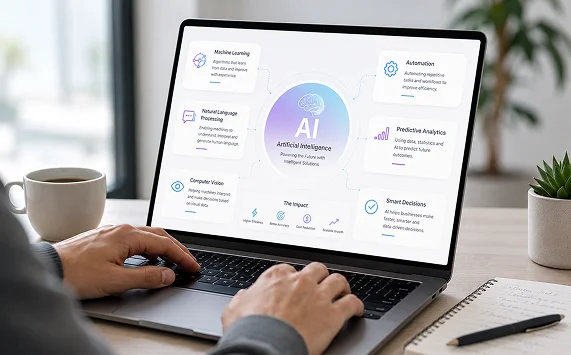
Today, we stand at another transition point from rule-based systems to intelligence-assisted systems. AI is not treated as a buzzword or a feature at Image Online. It is an augmentation layer.

We use AI where it adds value in analytics, pattern recognition, automation, decision support, optimisation, and insight generation. These capabilities sit on top of robust operational systems, not in isolation.

AI, for us, is meaningful only when it is grounded in clean data, disciplined workflows, and reliable execution systems all of which we have been building for decades.

Entering the AI-Assisted Era

Technology as an Evolving Capability

The most crucial distinction in Image Online’s technology approach is this: clients are never locked into a stack.

Technology choices evolve with the project. As scale increases, users grow, or complexity deepens, systems are rebalanced  without starting over, without vendor switching, and without disruption.

It’s possible because our engagement models are long-term, our teams are dedicated, and our thinking is architectural rather than tactical

Technology as an Evolving Capability

Global Readiness, Built-In

Having served global clients for decades, our technology approach is inherently international. Systems are designed for multi-country usage, scalability, security, performance, and compliance. Our teams operate with global standards, while cost efficiencies are delivered through structured offshore execution.

Making Image Online uniquely positioned to serve organisations across industries, geographies, and growth stages without the fragility typically associated with outsourcing.

Global Readiness, Built-In

The Bottom Line

Technology at Image Online is not a checklist. It is a lived capability built over three decades.

From PHP and MySQL to mobile, from ERP systems to fintech platforms, from learning systems to AI-assisted operations we do not chase tools. We understand systems.

Anything that runs on a browser or a mobile device can be built. Any industry can be served. Any solution can be engineered

Because technology is not what we use. It is what we have grown up with.

The Bottom Line

Leverage modern technologies, AI, and scalable digital architectures to build future-ready platforms that drive innovation, efficiency, and sustainable growth.

Talk to Our Experts